Author Archives: Sarah

The Sophisticated Art Patron

MALAYSIA’S PREEMINENT ART PATRON AND COLLECTOR, ZAIN AZAHARI, LAUNCHES THE THIRD VOLUME OF HATI & JIWA: THE ZAIN AZAHARI COLLECTION

A gentleman with an immense appetite for collecting works of art, Zain Azahari Zainal Abidin, also known as Pak Zain, has amassed an incredible number of artworks — over 1,000 paintings and sculptures by notable Southeast Asian and international artists. Now 84, he began his lifelong journey of art collecting in the 1960s.

If one wonders where all the paintings are kept, well, they are spread out systematically — on the walls of his office, his children’s homes and his private museum, Galeri Z. A great number are in secured storage — not in a state of neglect but rather, stored in a climate-controlled environment and cared for by a professional conservator who inspects them periodically.

When Pak Zain was a law student in London in the 1950s, he played the saxophone and began collecting jazz records,amassing about 8,000 records,which he keeps till this day. Also an avid reader, Pak Zain immerses in the poetry of Rumi, and his rotational reads include the same books by the revered poet.

His interest in arts and culture was nurtured as a student. “On weekends, besides visiting art galleries and museums, I also attended art lectures organised by institutions like the Royal Academy of Arts and British Council. I was aroused not just by looking at paintings, but understanding them too. I would pick up a copy of What’s On in London, a weekly magazine, and attend the art events in my free time,” recalls Pak Zain.

Pak Zain has built an illustrious career in law,founding Zain & Co in 1970.Today,his law firm is a member of Dentons, one of the world’s largest law establishments with presence in 78 countries, and is the sole representative for Malaysia.

Nowadays, he takes pleasure in viewing and coordinating his enormous art collection, playing with his grandchildren and teeing off to a game of golf with friends on weekends.Occasionally,he attends art openings as a guest of honour.A monthly lunch gathering with friends across the Causeway is also penned in his calendar.

But one of Pak Zain’s latest endeavours that has kept him occupied for the past year is the publication of Hati & Jiwa: The Zain Azahari Collection Volume 3, which was launched on April 20.

Featuring over 500 artworks from the region and beyond,and acquired between 2015 and 2019, volume three comprises four books, exquisitely designed and packaged as a box set. Thematically categorised as Landscape,Figurative,Abstract and Other Regions,the publication’s concept is influenced by the weight of contemporary artworks by emerging artists and the commissioning of a new editorial team that embody the freshest of The Zain Azahari Collection.

Led by Galeri Z manager Haslinda Hussein, the project members of Hati & Jiwa Volume 3 include Singaporean curator Syed Muhammad Hafiz Syed Nasir,writers Anita Kandhavel and myself,photographer Puah Chin Kok and designer Lim Oon Soon.

“Haslinda is a chartered accountant by profession. Brilliant and professional, she has played a pivotal role in this project. Lucky for me as she is also married to my youngest son, Zain Azmir,” says Pak Zain.

THE ZAIN AZAHARI COLLECTION

In Hati & Jiwa Volume 3, Pak Zain starts off by quoting Rumi: “When you do things from your soul,you feel a river moving in you,a joy”,aptly encapsulating his emotions from the pleasures of art appreciation.

The contemporary appeal of Pak Zain’s recent acquisitions provides an insight into his collecting method.Apart from significant paintings by modern masters such as Latiff Mohidin, Datuk Syed Ahmad Jamal, Datuk Ibrahim Hussein, Yeoh Jin Leng, Khoo Sui Hoe and Jolly Koh, a majority of the artworks in volume three are by established and up-and-coming regional contemporary artists.

“At this juncture, I would like to have major artworks that can enhance my collection.The procurement process requires me to explore my inventory and conduct a comparison with what I regard as my best of that artist. I will ask myself: ‘Is the artwork comparable to, equal to or better than what I already have?’

“A classic example is Noor Mahnun Mohamed’s Lanterns. The artwork complements the other painting that I already have, Girl Skipping. Both are from The Edge Auction. I felt the need for not just one painting to represent the artist in my collection. I would like to have a couple and it must be quality work. This particular artwork, for instance, is finely executed and meaningful because it promotes peace. Also, both styles are different. Each painting shows the artist’s capability to render landscape and figurative [elements]. So, in that sense, it elevates my collection,” explains Pak Zain.

Noor Mahnun’s Girl Skipping graces the cover of Hati & Jiwa Volume 3’s Landscape book.This painting was also featured on the cover of Noor Mahnun’s exhibition catalogue during her sixth solo show in 2002. It was offered at The Edge Auction last year.

Also in Landscape is a set of mixed-media work by Ahmad Shukri Mohamed, acquired from the artist’s solo exhibition Made in Malaysia: Works by Ahmad Shukri Mohamed from 2010 to 2017 at The Edge Galerie in 2017.

“Certain works by promising young artists in my collection may not necessarily advance my collection, but that’s my way of supporting them so that they don’t disappear off the radar. Some of them have found success while others may have gone astray from the art scene,” says Pak Zain.

Contemporary artists whose works are featured in Landscape include Anisa Abdullah, Syed Fakaruddin, Najib Ahmad Bamadhaj, Samsudin Wahab, Yeoh Choo Kuan, Aely Manaf, Gan Tee Sheng and Ilham Fadhli Shaimy aka Kojek.

Among the modern artworks in this segment are Yong Mun Sen’s watercolour painting titled Batu Caves, dated 1943; Khalil Ibrahim’s oil on canvas painting dated 1955; Abdullah Ariff’s Misty Morning, dated 1960; and a suite of watercolour paintings by A B Ibrahim, circa 1960s.

In the Figurative book, Dzulkifli Buyong’s Kucing Sakit is featured on the cover. Within the pages of this book, an eclectic range of styles entices Pak Zain, from artworks by Ahmad Zakii Anwar, Nadiah Bamadhaj, Jalaini Abu Hassan, Anthonie Chong, Chong Siew Ying, Chang Fee Ming, Hamir Soib @ Mohamed, Yusof Majid, Umibaizurah Mahir @ Ismail and Eng Hwee Chu to paintings by Chong Ai Lei, Fawwaz Sukri and Amy Nazira.

In selecting superior artworks, Pak Zain looks for technical complexity and intricacy before procuring them. Other factors include contextual meaning and visual appeal.

“I recently purchased an exceptional batik painting by Ismail Mat Hussin that was finely executed. Its background hue is blue, which is unique because Ismail typically uses earthy tones like brown. It’s twice the size of another painting, Kilang Batik. It makes a good addition to my collection by the artist,” says Pak Zain.

Measuring 96cm by 186cm, the 2008 untitled work depicts a coastal view of fisherfolk returning from sea. It fetched RM140,000, a record for the artist at an auction.

Latiff, a long-time friend of Pak Zain’s, has written an introduction for the Hati & Jiwa suite. His painting, titled Yellow Seascape, is depicted on the cover of the Abstract book.

“When I returned from my studies in the late 1950s and began practising law, I attended an exhibition by Latiff Mohidin at the foyer of the AIA building in Jalan Ampang. I acquired my first Pago Pago for RM150. It seems very little now, but in those days that was a lot for me,” recalls Pak Zain.

Among Latiff’s artworks in his collection are a stainless steel sculpture, titled Khat 2, and a resin sculpture, Object 1, acquired from Latiff Mohidin: Modern Sculptures 2007-2015, a solo exhibition curated by T K Sabapathy at The Edge Galerie in 2016.

Other heavyweights in this category include paintings by Datuk Sharifah Fatimah, Datuk Tajuddin Ismail, Sulaiman Esa and Zulkifli Yusoff.

The next generation of abstract painters whose works have found a permanent home in The Zain Azahari Collection include Fauzul Yusri, Sabri Idrus, Zulkifli Lee,Haffendi Anuar,Roslina Lyne Ismail,Khairul Izham,Saiful Razman,Wong Perng Fey, Hasanul Isyraf Idris and Faizal Suhif.

For Other Regions, a set of insect drawings by Walter Spies, dated 1922, is the oldest in Hati & Jiwa Volume 3. The drawings signify the artist’s early record of entomology created before Spies settled in Bali in 1927.

An untitled painting by leading Indonesian contemporary artist Yunizar — known for his stylised pictograms and coretan or scribbles — graces the cover of this book.The large-scale and vibrant painting defines Pak Zain’s fresh palate.

Among the international artists whose works are in The Zain Azahari Collection include Natee Utarit,Sinta Tantra,Sun Xun,A D Pirous,Kemal Ezedine, Harlen Kurniawan, Ketut Karim, Jamie Tan You Kean, Ruben Pang, Melissa Tan, Min Wae Aung and Tricia Gillman.

The latest addition to the ever-growing collection is a group of exquisite paintings previously owned by his brother, the late Tan Sri Zain Azraai. Purchased from his brother’s family last year, the remarkable works are by modernists Datuk Ibrahim Hussein, Datuk Syed Ahmad Jamal, Yeoh Jin Leng, Khoo Sui Hoe, Jolly Koh, Dzulkifli Buyong and Brazilian artist Calasans Neto.

HEART AND SOUL

The first two volumes of Hati & Jiwa began in the 1960s when Pak Zain received his first artwork — a wedding gift by a former classmate in 1962. Dated 1961 and titled Batu Caves, the watercolour painting is by Datuk Syed Ahmad Jamal.

This prized artwork was among a selection of 40 paintings from Pak Zain’s private collection that was exhibited at The Edge Galerie’s inaugural collector’s show, Favourites from the Zain Azahari Collection in October 2013.

“I don’t usually loan my artworks to art galleries or institutions. My collection is my personal joy and the experience of collecting has been extremely rewarding in so many personal ways,” says Pak Zain.

The only other occasion that he allowed his artworks to be loaned was for the seminal show, Latiff Mohidin Pago Pago (1960-1969). Six of his eight Pago Pago masterpieces were carefully packed and shipped to Centre Pompidou in Paris last year.

Presented by the National Gallery Singapore in collaboration with the National Museum of Modern Art, the survey exhibition showcased some 70 works from the modernist’s celebrated Pago Pago series.

Pak Zain’s contribution to the arts is beyond economic. The beneficiary of his patronage is not just the arts and culture ecosystem but also the general public, through his generosity in loaning invaluable masterpieces, displaying his art collection in his private museum,which can be viewed by appointment, and publishing his collection for art students and researchers.

When The Edge Galerie invited Pak Zain to partake in a survey for Southeast Asian Art: Auction Benchmarks & Market Insights — a publication to track the Southeast Asian art market last year — he accepted with earnestness.

The Zain Azahari Collection, which began as a diversion, has matured into a family heirloom. In Hati & Jiwa Volume 3, Pak Zain wrote a heartfelt dedication for his 11 grandchildren: “Since they arrived, I have begun to contemplate the role that art may play in their lives and conversely the roles that they might play in preserving these works, which have so enriched my life. My message to them is simple. In art and in life, approach everything that you do with your heart and soul and in so doing, the truth will inevitably chart your course. Finally, be sure to know that you are the most perfect works of art bestowed on me from above by the greatest Artist of all.”

Link to pdf

Exquisite Art Coming Up for Sale

The Edge Auction 2019 has on offer highly desirable and collectible artworks by top Malaysian artists as well as leading contemporary artists from Southeast Asia

The seventh edition of The Edge Auction will see 105 lots comprising modern and contemporary Southeast Asian artworks go under the hammer on March 17.The cover lot,Kambing Hitam (2009), is a painting by Malaysian contemporary artist Hamir Soib @ Mohamed and has an estimated price of between RM80,000 and RM150,000.

Measuring 198cm by 300cm, the mixed media on canvas depicts a trio of goats floating in a mountainous landscape. The treatment of the background in layers of bitumen and black oil and acrylic paint in a rectangular layout is reminiscent of Chinese ink-and-wash landscape paintings.

Hamir and fellow founders of the Matahati collective — Ahmad Shukri Mohamed, Ahmad Fuad Osman, Bayu Utomo Radjikin and Masnoor Ramli Mahmud — presented their artworks in a group exhibition entitled Matahati ke Mata Dunia (Matahati in the Eyes of the World) in Los Angeles, the US, in 2009, the same year Kambing Hitam was painted.Hamir’s experience as a theatre-set artist enabled him to execute large-scale paintings such as this lot but his style of painting has evolved over the years, making Kambing Hitam a desirable work from this period.

Also on offer are three paintings by Matahati co-founder Shukri, entitled Barcode Series: White Haze (1998), Progeny 3 and Progeny 4 (2001).

Progeny 3 and Progeny 4 feature an egg in positive and negative space. Inspired by a bantam breed of chicken called Serama and a lucrative pageant industry revolving around the fowl in Kelantan where Shukri was born, Progeny is the artist’s response to the local environment.The complexity of the pair of works — a collage on canvas created using layers of silkscreen on fabric — is a feature of Shukri’s early work.

Estimated at between RM18,000 and RM30,000 each, the artworks were created before Shukri’s residency at Rimbun Dahan, where he conceived his celebrated Incubator series. At the end of his residency, he exhibited two installations based on the concept of incubation.As described by Stephanie Ho on Rimbun Dahan’s website, they comprise “structures filled with hundreds of white and black plaster eggs,drawing on the yinyang concept to suggest the inevitably heterogeneous nature of the world. As Shukri puts it, within a hundred white eggs there will be a black egg, and vice versa”.

Established artists

Also up for auction are artworks by veteran artists Khoo Sui Hoe, Jolly Koh, Datuk Sharifah Fatimah Syed Zubir, Datuk Tajuddin Ismail and Yusof Ghani.

Khoo’s Lake Merah (2002) was exhibited in his retrospective, The Painted World of Khoo Sui Hoe, at the Penang State Museum and Art Gallery in 2007. Estimated at between RM35,000 and RM50,000, the abstract painting is also featured in the exhibition’s catalogue.An earlier painting, Two by the Sea (1981), with an estimated price of between RM22,000 and RM30,000, gives buyers an opportunity to bid for the artist’s classic rendition of abstract figures.

Yusof Ghani’s Assembly I – Wajah Series measures 182cm x 182cm and is estimated at between RM115,000 and RM150,000
Conceived in New York, Fan Shell by Jalaini Abu Hassan is an important work that led to his iconic Re-Found Objects series

A Touch of Yellow (1996) by Koh depicts a vibrant abstract landscape in blue, green and yellow with a hint of red. Priced at between RM26,000 and RM48,000, it features the artist’s hallmark gestural brushstrokes in effervescent colours.

Sharifah’s Celebration 18B (2018) comes from an ongoing body of work called Celebration that began in 1996. It depicts a kaleidoscope of colours in several layers to form a floating scene of shapes in various magnitudes. The multi-coloured artwork in Sharifah’s distinctive style is estimated at between RM65,000 and RM75,000.

Assembly I (Wajah Series) (2007) by Yusof was exhibited in a solo exhibition at National Gallery Indonesia in Jakarta in 2010.The show featured works from his Wajah series created since 2006. Illustrating a group of anonymous faces hovering against a backdrop of gestural brushstrokes of bright red and yellow, the enigmatic painting radiates a strong sense of dynamism.

Tajuddin’s Blue Windrift (2001) is an example of the artist’s skilful combination of colour and shape in abstract form. His current body of works — as seen in his recent solo exhibition Ambiguity that featured abstract works in structured geometric shapes — is a departure from his early style of painting, making Blue Windrift a collectible artwork. It is priced at between RM29,000 and RM45,000.

Contemporary

Among the contemporary artists whose iconic works will go under the hammer next month are Ahmad Zakii Anwar, Jalaini Abu Hassan,Amron Omar,Noor Mahnun Mohamed,Wong Perng Fey, Chong Siew Ying, Kow Leong Kiang, Tan Wei Kheng and Anthonie Chong.

Ahmad Zakii’s Kecak under the Dark Moon (1994, estimated at between RM60,000 and RM80,000) was created during one of his many visits to Bali. According to the artist, he had traded the painting with its current owner in 1995 in exchange for two Ethiopian swords due to his personal interest in ethnographic arms and armour. The owner, who is a long-time friend of his, had served in the diplomatic corps in Addis Ababa in the late 1970s and had acquired the swords for their beauty and craftsmanship.

Khoo Sui Hoe’s tranquil Lake Merah depicts the horizon that can be seen either at dawn or dusk with a multi-coloured geometrical border to enhance the composition
Sharifah Fatimah Syed Zubir’s Celebration 18B is an interpretation of the joy of life

Ahmad Zakii had experimented with a special oil paint to produce the iridescent quality of Kecak under the Dark Moon to emulate the spiritual notion of the trance ritual. His fascination with Bali is conveyed through his paintings of the island’s traditional dances, such as Legong,which is also on sale in two sets of sketches estimated at between RM6,000 and RM10,000 for each set.

Jalaini, or Jai as he is popularly known, is represented by one of his early works, Fan Shell. Conceived in New York in 1995 when Jai was completing his master of fine art at Pratt Institute, this work was completed in Kuala Lumpur and displayed in a solo exhibition entitled Lifeform at Gallerie Taksu in 1996.

Noor Mahnun’s Lanterns (2013) depicts a young girl holding a bouquet of Japanese lantern flowers. Standing on a hollowed platform — with a deliberate arrangement of symbolic objects such as a pair of scissors, a glass vase containing three marbles and a pink perfume bottle — the female subject is a portrait of Noor Mahnun’s relative. Also seen in the painting are the artist’s characteristic geometrical shapes that form the floor tiles and shoji doors as well as a figurine of Disney’s Bambi placed at the edge of a table.

Lanterns was displayed in a charity exhibition at the Nalanda Centre in Selangor to raise funds for a documentary on Buddhism. Entitled A Journey of Self Discovery, the show was curated by the late Syed Nabil Syed Nahar of NN Gallery.

Estimated at between RM65,000 and RM75,000,Lanterns is expected to attract the interest of collectors due to its painterly quality and scale.Paintings of this size — 182.5cm by 121.5cm — have rarely been executed by the artist in recent years. Her paintings in her solo exhibition, Disco Lombok Still Life by Noor Mahnun, at The Edge Galerie in 2017 were relatively small.

Progeny 4 by Ahmad Shukri Mohamed was first shown at a solo exhibition in Kuala Lumpur in 2001
Lanterns by Noor Mahnun Mohamed corresponds with Zen Buddhism and was first displayed at the Nalanda Centre in Selangor

Alternative media and regional artworks

In this sale, an exciting segment of fabric and batik art will feature works by contemporary artists Azam Aris, Anne Samat and Fauzin Mustafa as well as veteran artists Datuk Tay Mo Leong, Lee Long Looi and the late Ismail Mat Hussin.

Nanyang-style artworks will include paintings by Tan Choon Ghee, Tew Nai Tong, Datuk Tang Hon Yin, Peter Liew, Lui Cheng Thak, Lee Weng Fatt, Eston Tan, Alex Leong and more.

Also on offer is a diverse selection of regional art, including works by Indonesian artists Jeihan Sukmantoro,I Wayan Sujana (Suklu), Gede Putra Udiyana, Yunizar, Besta Bestrizal, Dedy Sufriadi, Indra Dodi, Harlen Kurniawan; Singaporean artist Anthony Chua Say Hua; Vietnamese artists Thanh Chuong, Nguyen Thanh Binh and Bui Huu Hung; and Myanmar artists Win Pe and Myint Soe.

The Edge Auction 2019 will again offer live online bidding through Invaluable.com for its growing international clientele, alongside the conventional absentee and telephone bidding options.

Link to pdf

Southeast Asian Art: Auction Benchmarks & Market Insights

Publisher: The Edge Galerie & The Edge Media Group
Artist(s): Latiff Mohidin, Syed Ahmad Jamal, Ibrahim Hussein, Jolly Koh, Khoo Sui Hoe, Khalil Ibrahim, Chang Fee Ming, Chia Yu Chian, Chen Wen Hsi, Georgette Chen, Cheong Soo Pieng, Raden Saleh, S. Sudjojono, Lee Man Fong, Hendra Gunawan, Juan Luna, Jose Joya, Anita Magsaysay-Ho, Ang Kiu Kok, Le Pho, Joseph Ingiumberty, Nguyen Phan Chanh, Thawan Duchanee, Natee Utarit, Montien Boonma, Korakrit Arunanondchai, Myo Khin, Ngwe Gaing, San Win, U Ba Thet, U Lun Gwye
Author(s): Johnni Wong & Sarah Abu Bakar
Interviewees: Zain Azahari, Jalaini Abu Hassan, Pakhruddin Sulaiman, Lim Wei-Ling, Kenny Teng, Christopher Tung, Wang Zineng, Talenia Phua Gajardo, David Fu, Alice Zou, Ben Rush, Charles Liu, Jimmy Chua, Lorenzo Rudolph, Victoria Huang, Seah Tzi-Yan, Lindy Poh, John Andreas, Edwin Rahardjo, Christiana Gouw, Nancy Nan, Wiyu Wahono, Jaime L. Ponce de Leon, Ramon E.S. Lerma, Nguyen Thi Thu Suong, Celine Alexandre, Zoe Butt, Adrian Jones, Nguyen Hong Lam, Pho Duc Long, Lai Thanh Mai, Le Trung Thanh, Jorn Middelborg, Panada Lerthattasin, Sai Wannaphon Chimbanchong, Vasan Sitthiket, Min Wae Aung, Min Maw Aung, Gill Pattison, Nathalie Johnston, Myint Soe
Printer: KHL Printing Co Sdn Bhd
Publication Date: 2018
Binding: Softcover
ISBN: 978-967-16294-0-6

Bracing the Heat by Fauzan Omar

Date: September 6 – 19, 2018
Venue: The Edge Galerie, G5-G6, Mont’ Kiara Meridin, 19 Jalan Duta Kiara, Mont’ Kiara, 50480 Kuala Lumpur (permanently closed)

Bracing the Heat is the eighth solo exhibition by established artist, Fauzan Omar highlighting serious environmental issues that the world is facing today.

BURNING ISSUE

Recently-retired art educationist Fauzan Omar has reached a milestone in his art career. Finally free from the rigours of academia, 67-year-old Fauzan has devoted all his energies in the past year to come up with an astonishing 200-odd pieces of artworks that form 13 captivating sets to express his long burning concern about the dire straits of our natural environment.

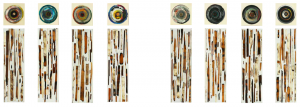
In his latest solo exhibition, Bracing the Heat, Fauzan — one of Malaysia’s most respected contemporary artists — offers scorched wood collages and images of orbs as well as his signature paintings and carved motifs to reflect the flora of the Malaysian rainforest under threat from climate change.

But given his technique of intense layering of motifs and colours, Fauzan’s latest works are not overtly concerned about death and destruction. Rather, they are about nature coping with the dire consequences of mankind’s unbridled greed for land resources, and so on.

Land clearing schemes — whether legal or not — come immediately to mind. Large-scale destruction of rainforests in the name of progress to come up with modern plantations will eventually bring consequences, as Fauzan alludes to in his work. To depict bare landscapes would be too conventional a composition. His contemporary works always have a certain delicate element of beauty. To fully appreciate the full extent of their impact, the artworks have to be viewed in a proper gallery setting.

Fauzan has been involved in the arts for some 30 years, devoting most of his waking hours to educating and nurturing art students. He has been a mentor to quite a few artists, including Ahmad Shukri Mohamed, whose Made in Malaysia exhibition was held at The Edge Galerie from
Sept 27 to Oct 13 last year. The senior artist is also a close friend of Shukri’s wife and fellow artist Umibaizurah Mahir @ Ismail, who has also exhibited with The Edge Galerie (Fragile, July 20 to Aug 5, 2016). In fact, it was Umibaizurah who suggested that Fauzan show his work in our gallery.

Since retiring from Universiti Sains Malaysia last year, Fauzan has worked feverishly to transform the long-simmering ideas in his head into the works that we see today. The pieces selected for this exhibition are deemed to be the best in his new series.

ARTWORKS

Link to pdf

When I See You Again by Chong Ai Lei

Date: January 11 – 20, 2018
Venue: The Edge Galerie, G5-G6, Mont’ Kiara Meridin, 19 Jalan Duta Kiara, Mont’ Kiara, 50480 Kuala Lumpur (permanently closed)

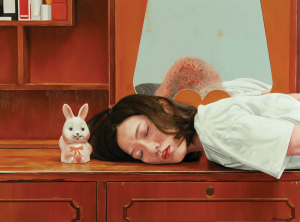
Rising contemporary artist Chong Ai Lei presented her fourth solo exhibition and the first in her home country entitled When I See You Again, which featured eight contemplative paintings recalling her childhood memories.

SENTIMENTAL AND NOSTALGIC

Unabashedly sentimental and nostalgic, the latest works of contemporary artist Chong Ai Lei, 33, mark her first solo show in Malaysia.

Despite having participated in many group shows locally and three solo shows overseas, this is the first time the fine art graduate is staging a solo exhibition in her home country.

Entitled When I See You Again by Chong Ai Lei, the show will be held at The Edge Galerie and will feature eight large oil paintings. The format of the self-portraits is either 230cm by 170cm or 170cm by 230cm. The paintings convey a nostalgic yet melancholic mood as Chong revisits her childhood home in Segamat, Johor, where she was raised. The various rooms of the house serve as the backdrop for her paintings.

Chong depicts herself wearing clothes that were owned or passed down by her mother, alongside a myriad of personal belongings and furniture. All the spaces and items tend to relate to a specific
memory.

In a work entitled Jackfruit, the artist is in a green dress, one that her mother had worn in her younger days. Chong grips a nangka by the stem as she walks past the front door of the house. The artist recalls how the jackfruit seemed always to be in season and how its smell reminded her of her childhood.

A dressing table at which Chong and her sisters readied themselves for school and a money box, the first-ever present given by the artist’s father, are both seen in Rabbit Money Box.

Indeed, Chong’s compositions are filled with a sentimentality that documents her growing years in an ordinary Chinese household.

When I See You Again by Chong Ai Lei is The Edge Galerie’s first exhibition for 2018 and it is being held with the support of leading property development company, Matrix Concepts.

ARTWORKS

Link to pdf

Latiff Mohidin: Painted Steel Sculptures

Date: December 11, 2016 – January 30, 2017 (extended)
Venue: DUO Galleria, Unit 01-21, 7 Fraser Street, Singapore 189350

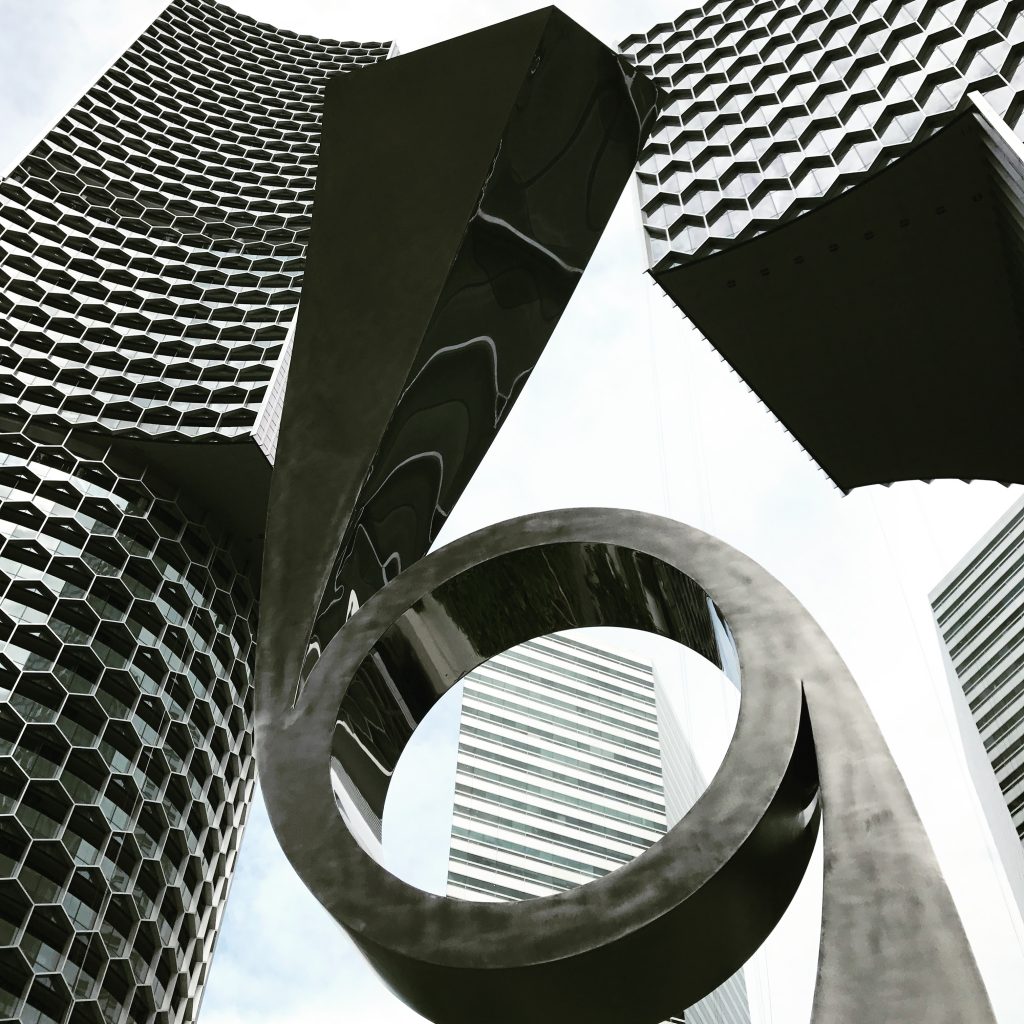
Distinguished Malaysian artist Latiff Mohidin has created a monumental steel sculpture in Singapore at DUO, a contemporary twin building designed by German architect Ole Scheeren. In conjunction with the official launch of DUO on January 15, 2018, the special showcase of Latiff’s modern sculptures entitled, Latiff Mohidin: Painted Steel Sculptures was held at the DUO Galleria art space unit. Six steel sculptures in various forms and finishes were on display.


Symbol of Harmony

Distinguished Malaysian artist Latiff Mohidin has created a monumental steel sculpture in Singapore at DUO, a contemporary twin building designed by German architect Ole Scheeren.

Inspired by nature, Harmony is a freestanding modern sculpture by top Malaysian artist Latiff Mohidin. Standing at nine metres, the outdoor artwork is located at the central plaza of the DUO building in the Bugis district of the city state.

The design, which was inspired by the interlocking motif of plant leaves, reflects the yin and yang concept of two forces coming together and complementing each other — reflecting the harmonious relationship between Singapore and Malaysia.

In conjunction with the launch of DUO, there will be a special showcase of Latiff’s modern sculptures. Entitled, Latiff Mohidin: Painted Steel Sculptures, the exhibition will be held at the DUO Galleria art space unit from now until Jan 19. Visitors will be able to view the six steel sculptures in various forms and finishes.

DUO is an integrated development by M+S, which is jointly owned by Malaysia’s Khazanah Nasional and Singapore’s Temasek Holdings. The development spans 1.73 million sq ft and has a gross development value of about $4 billion. DUO comprises premium apartments called DUO Residences, DUO Tower offices, DUO Galleria retail space and the luxury-class Andaz Hotel.

In an email interview, Latiff, 76, explains, “Harmony was shipped to Singapore and erected at the DUO Galleria central plaza at 7 Fraser Street on Sept 26 last year.

“I was asked to design a freestanding sculpture to be placed at an area near Arab Street in Singapore. It should be tall enough as a landmark to be seen from different angles. So I proposed and submitted a simple design with a few drawings and a small-scale model. Once accepted, then it was all work until it was completed.

“There [were] several important stages during the making of Harmony. Firstly, the fabrication stage. This is the stage when the designer/sculptor is challenged aesthetically; the builder is challenged architecturally; and the engineer is challenged by its mechanism. This is followed by the transportation stage, from Xiamen in China, where it was fabricated to be brought to the actual site in Singapore. Finally, comes the most ‘crucial stage’ of erecting it for good at DUO. Meaning, the sculpture should be standing solid, intact and safe for many, many years to come.”

When asked, what he aspires to achieve when creating outdoor sculptures, Latiff says: “If one could enjoy its appearance, its physical presence in a selected space, location or environment — particularly when light falls on its shape or form or volume, then I think I have achieved an important aspect of the creation.”

The response from the public is certainly one of Latiff’s concerns when designing an outdoor sculpture. He says: “The sculpture as a freestanding artwork is created for public pleasure. They are free to feel and to react as they like, enjoying its beauty and its durability. That is the reason why, when designing an outdoor sculpture, I am very concerned [about] its regular maintenance.”

Latiff first embarked on creating sculptures as an art student in Berlin in 1961. “A friend who was a student of Prof Karl Hartung taught me how to build up shapes/forms from plaster of Paris. Later in 1967, in Singapore and Kuala Lumpur, I made a series of small sculptures with Pago-Pago shapes or pagopago-esque. In the early 80s, I did about 50 pieces of soldered brass,” says the artist, in reference to his famous Pago-Pago series of paintings and drawings from the 1960s. Incidentally, Latiff will be honoured with a retrospective show of his Pago-Pago works at the Centre Pompidou in Paris from Feb 28 until May 28 next year.

“I will be displaying six sculptures in Latiff Mohidin: Painted Steel Sculptures. Two sculptures are entitled Isfahan 2 and Isfahan Green and were done in 2015. Yin Yang is a new work (2017) made of stainless steel and another sculpture entitled 3-in-1 was created in 2016. Two other sculptures, Growth 1 and Growth 2, were completed in 2011 and were exhibited with my other ‘modern sculpture’ works at The Edge Galerie in Kuala Lumpur in 2016,” explains Latiff.

Originally published at: https://www.theedgesingapore.com/native-ad-opx-lifestyle/symbol-harmony

Disco Lombok Still Life by Noor Mahnun

Date: November 23 – December 10, 2017
Venue: The Edge Galerie, G5-G6, Mont’ Kiara Meridin, 19 Jalan Duta Kiara, Mont’ Kiara, 50480 Kuala Lumpur (permanently closed)

Comprising over 50 works that feature drawings of intricate geometric patterns, quirky illustrations of squids as well as delicate portraits on paper and oil paintings of still life on linen, this exhibition demonstrates the Noor Mahnun’s wry observations of life.

MARCHING TO THE BEAT OF HER OWN DRUM

Tabula rasa: An absence of preconceived ideas or predetermined goals; a clean slate.

WIDELY KNOWN AS Anum on the Malaysian art scene, Noor Mahnun Mohamed, 53, may be petite but she ably juggles the roles of painter, curator, writer and educationist.

Born in 1964 in Kelantan, she graduated with a master’s in fine art from Hochschule für Bildende Künste, Braunschweig, Germany, in 1996.

After returning to Malaysia at the end of 1997, Noor Mahnun kicked off her versatile career in the arts with a job as graphic designer. In 1998, she staged her first solo exhibition in Malaysia and participated in group shows. In the following year, she took up a teaching post in several local institutions and continues to lecture on art theory until today.

From 2000 to 2001, Noor Mahnun was an artist-in-residence at Rimbun Dahan in Kuang, Selangor. She concluded the programme with an exhibition of paintings produced on site and inspired by the location. From 2006 to 2012, she worked as an arts manager at Rimbun Dahan.

The Italian Ministry of Foreign Affairs then offered the artist a government scholarship to take up a printmaking course at Il Bisonte, Florence, from 2002 to 2003. Upon completing the course, Noor Mahnun returned to Kuala Lumpur and ventured into curatorial work at the Valentine Willie Fine Art gallery from 2003 to 2005. During her stint there, she organised 10 exhibitions by Malaysian and Southeast Asian contemporary artists and wrote for the shows.

She has written over 30 essays and reviews of art shows in Malaysia and, in 2015, contributed an academic paper entitled Printmaking Archive for Reference, Research, and Regional Links to a Nippon Foundation Fellowships for Asian Public Intellectuals publication called Encountering Asian New Horizon: Contesting and Negotiating in Fluid Transitions, The Work of 2012-2013 API Fellows.

Her talent does not end there. Noor Mahnun is proficient in Bahasa Malaysia, English and German, and her competence in the German language saw her participate in German-Malay translation workshops with Holger Warnk and Hedy Holzwarth — who are lecturers at the Goethe-University Frankfurt am Main Institute for East Asian Philology, Southeast Asia Science — organised by Goethe-Institut Malaysia in 2007.

Noor Mahnun also designed the book cover for a publication entitled Ingin Sebebas Burung/Flugversuch, Antologi Dwibahasa Cerpen Malaysia dan Jerman Zweisprachige/ Anthologie Malaysischer und Deutscher Kurzgeschichten, for which she was one of the translators. This project was coordinated by Goethe-Institut Malaysia with Institut Terjemahan Negara Malaysia as the publisher.

The artist’s latest solo exhibition at The Edge Galerie is entitled Disco Lombok Still Life by Noor Mahnun. Over 50 artworks comprising oil paintings and drawings will be on view from Nov 23 to Dec 10.

The show’s intriguing title is but a glimpse of Noor Mahnun’s alternative approach to staging an art exhibition.

STILL LIFE

On the surface, Noor Mahnun’s paintings appear to be European in style — still lifes featuring a single domestic object illustrated in the academic method or figurative and portrait paintings that resemble the works of German painter Otto Dix (1891-1969), who fused elements of realism, allegory and the whimsical. However, Noor Mahnun’s depiction of the human figure on canvas is devoid of emotion, focusing on physicality rather than expressiveness. Be that as it may, her time spent in Europe seems to have influenced her painting style the most.

Self-expression appears to the central idea of Noor Mahnun’s work. It is an archive of memories, an attempt to eternalise certain episodes of her life. Her choice of subjects in Disco Lombok Still Life include the ordinary coffee moka pot; butter and steak knives; dustpan and brush; scissors; white gloves; and sunglasses. Yet, the narratives of these objects are deeply personal.

For instance, in an artwork entitled Butter Knife, the knife was a gift from one of Noor Mahnun’s architecture students in Universiti Malaya, where she was lecturing part-time in 2015. Delighted yet anxious about the gift — which symbolised the severing of friendships — Noor Mahnun offered her student a token fee as an act of preserving their friendship.

As for the painting of a pair of white gloves, the artist referred to it as the Tiara and said it signified cleanliness and professionalism. Apparently, on her travels in Japan between 2012 and 2013 as a senior fellow of the Nippon Foundation Grant for Asian Public Intellectuals, Noor Mahnun noticed that a lot of people in different professions wore white gloves — from police officers and taxi and bus drivers to bellboys.

“Apparently, when The Beatles came to Japan in 1966, the police in charge of security came up with the idea of wearing gloves to add a level of ‘propriety’ between their hands and the fans as it was the duty of each officer to hold back the enthusiastic crowd,” she says.

Interestingly, an article entitled White Gloves by Alice Gordenker was published in The Japan Times on March 19, 2013, about a fascinated reader who wrote to Gordenker to express his curiosity about the white glove phenomenon in Japan1.

Noor Mahnun’s depiction of domesticity is presented in a small, rectangular format — a reflection of a woman with a paintbrush — dainty and ordered. Evident in her work is her obsessive fascination with geometric patterns, perhaps, a therapeutic means to escape the chaos of her daily schedule of organising art events, teaching and/or writing about art.

“When I first arrived in Berlin in the early Eighties and visited the Neue Nationalgalerie, I was in awe of the architecture of Mies van der Rohe: the iron pillars, beams, columns. The building is much better seen and experienced in real life. My interest in patterns and tiles started then,” she explains.

In Dustpan & Brush, Noor Mahnun employs repetitive geometric patterns as a backdrop to the good old brush and dustpan, which is presented as a triptych. The task of creating the composition from basic lines came from her interest in architecture.

“I chose basic homeware as subject matter because I enjoy domesticity and doing chores like cleaning, sewing and ironing. I like being at home, perhaps that is why (incidentally) my work studio is located above my apartment, which is convenient,” says Noor Mahnun.

BECOMING ZEN

In an artwork entitled Rooster and Head, Noor Mahnun uses the image of the head of Buddha in Gandharan style paired with a rooster in a box.

“The Gandharan Buddha is culturally significant because it is an artistic manifestation of early Buddha statues — the Gandhara region was a meeting point of the classical Greek style and Buddhist art, a cultural crossroads of influence that I find interesting,” she says.

“But when I started the painting, pairing these two objects was purely a random (visual) act. The head was seen in Singapore in an art of ethnographic museum display exhibition. The rooster was sighted in a newspaper article. Somehow, placing the two together on a picture plane seemed apt. The readings were formed later. Could go in many ways and tangents …”

“My master’s degree paper was about Leon Battista Alberti, his idea of ‘Disegno’, written under the subject of aesthetic philosophy. He is definitely a typical Renaissance man. A humanist, author, artist, architect, linguist, mathematician, poet, priest, philosopher and cryptographer,” adds Noor Mahnun, who is a fan of the Renaissance period.

In another painting entitled Postcard from Tumpat (40cm by 120 cm), she illustrates the iconic sleeping Buddha in Wat Photivihan, a temple located in Kampung Jambu, Tumpat, situated north of Kota Baru, Kelantan. Spanning 40m, the statue is said to be the longest in Southeast Asia.

“I was trying to capture the naivety of the sculpture. Of being at peace or resting. Which brought to mind Goya’s Sleep of Reason, a favourite artwork. I was also thinking of a painting I saw in Tokyo by Takanobu Kobayashi. But of course the ‘recline’ theme recurs in the arts, the Etruscan (tomb) murals and the figures on top of their sarcophagi, for example. I find it all intriguing.”

DISCO LOMBOK

“All of my past solo exhibitions have been associated with a musical performance. I like singing and dancing. Music plays an important part in my life,” says Noor Mahnun.

Thus, disco in this show represents her student days. “The mid-Eighties through the early Nineties were spent in Germany at the height of the rave culture there,” explains the artist, who witnessed the fall of the Berlin Wall as a student in 1989. In the spirit of egalitarianism, techno music unified people from East and West Berlin.

The significance of Lombok in this exhibition relates to the collaborative effort between Noor Mahnun and Dina Zaman, the writer of the book I Am Muslim. The Very Clever King of Lombok is a short story derived from a folk tale about a king on the Indonesian island of Lombok. A number of drawings displayed in this exhibition are part of the complete compilation, a work in progress as Noor Mahnun is still documenting visual research/ images to correspond with the text.

“I am hoping to use the sales proceeds of the Lombok series to visit the island as I continue to research illustrations for the short story. The Very Clever King of Lombok got me in deeper, into wanting to know more, about the Wallace Line between the islands of Lombok and Bali. I have always been a fan of Alfred Russell Wallace, so it was a good and happy coincidence when Dina approached me with the project. In Volume One of Wallace’s The Malay Archipelago, the land of the orang-utan and the bird of paradise, Chapter XII was solely about ‘Lombock: How the Rajah Took the Census’. The book itself was dedicated to Charles Darwin,” chirps Noor Mahnun.

POSTCARD, BLOOMS AND SQUIDS

Measuring 57cm by 76cm, Postcard from Delhi is a graphite drawing with a watercolour wash on paper. The postcard-size work was received by Noor Mahnun from her friend Lim Oon Soon, a graphic designer. She illustrates realistically the card as well as the message written on it in watercolour.

In its actual format, this work demonstrates Noor Mahnun’s impeccable skills and her aptitude for detail. Divided into two parts, the front of the postcard — “a reproduction of an old miniature painting” — is depicted on the left side of the paper, composed at the centre of a laborious grid pattern in graphite as background. On the left side, the artist illustrates immaculately the reverse side of the postcard, which features a handwritten message — complete with stamp and the sender’s drawing.

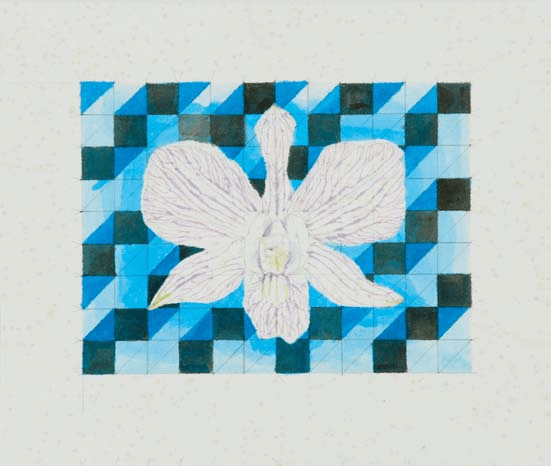
Also featured in this show are six watercolour paintings of females adorned with flowers, such as lady’s slipper orchids, tiger lily, frangipani and camellia. Noor Mahnun portrays herself in six personas decorated with various blooms and wearing different hairstyles. The artist jokes that being a model for her own work is easy because “my model is always punctual”.

Another quintessential theme of Noor Mahnun’s creative oeuvre is the depiction of squids and insects such as beetles, wasps and moths. Insects have been a favourite subject alongside geometric patterns since her days in Berlin.

In Disco Lombok Still Life, Noor Mahnun also showcases eight drawings of squids on paper. “The squid, against a repetitive pattern rendered in pencil, works on paper. My obsession started when I took part in My Story, My Strength: Doodle for Change, an exhibition in aid of the WCC (Women’s Centre for Change) in George Town, Penang, in 2015. At first, I wanted to convey the perseverance and patience of those women whose lives are affected by abuse,” explains Noor Mahnun.

“But in the process of doing the work, the rendering became an obsession, and I got addicted to drawing not only cuttlefish but also the patience-testing, long attention span this series demanded. I have always done patterns but not in minute detail. What was supposed to be an arduous and challenging task became a delightful occupation. I could go on rendering for hours. The ‘squid’ backfired, I suppose. It was chosen because it is languid in the way it moves. It’s smooth, slippery. But it can also swim speedily. Passive. Aggressive. The shape, phallic, has connotations. Being a printmaker, I have always admired Hokusai’s work and one of them featured an octopus and a woman. It is sensual, and I think sensibility is the right word to describe it.”

Here, Noor Mahnun is referring to The Dream of the Fisherman’s Wife, a woodblock print created in 1814 by renowned Edo period Japanese artist, ukiyo-e painter and printmaker, Hokusai (1760-1849). The image depicts a woman wrapped in the limbs of two octopuses performing erotic intercourse with her. Inscribed above the image in Japanese calligraphy is a text, which expresses the woman and the creatures’ mutual carnal pleasure.

FROM CHARITY TO COMMUNITY

As a devoted cultural ambassador, Noor Mahnun has dedicated her time and energy to education and to spreading social awareness by collaborating with organisations such as the Malaysian AIDS Foundation, Women’s Centre for Change, Penang, and Sisters in Islam.

She has curated several art exhibitions to raise funds for charity, such as Art for Nature for WWF Malaysia, ArtAid16 Love for Sale last year and ArtAid17 Bebas (Freedom) this year in support of the Malaysian AIDS Council.

In November, Noor Mahnun will curate and participate in a group exhibition of 21 artists entitled Hell, Heaven at Cult Gallery in Kuala Lumpur in collaboration with Sisters in Islam, an organisation that promotes women’s rights “within the frameworks of Islam and universal human rights”.

Her latest endeavour is as a curatorial consultant for Think City Johor Baru, working for the Iskandar Malaysia Community Public Art programme — a joint initiative between the Iskandar Regional Development Authority, Think City and Bandung Creative City Forum — which requires her expertise in residency programming gained from her experience at Rimbun Dahan.

With all these activities on her plate, one wonders how Noor Mahnun manages to find time to produce artworks or to relax. In the run-up to Disco Lombok Still Life, I had the privilege of visiting her studio and having numerous discussions over lunch, and I found that Noor Mahnun never leaves her studio without her schedule book, sticky notes, notebooks and writing tools, scribbling down every important detail (dates, appointments, to-do lists, ideas and sketches): a habit that keeps her prompt for our meetings.

Noor Mahnun is indeed a brilliant and independent woman whose career is not confined to art but also includes educational and cultural endeavours, a challenging task not many artists can accomplish.

ARTWORKS

Link to pdf