Author Archives: Sarah

Embracing Domesticity Through Still Life

Noor Mahnun Mohamed, 53, may be petite but she has held many roles, including that of a painter, curator, writer and educationist.

Born in 1964 in Kelantan, she graduated with a Master of Fine Art from the Hochschule für Bildende Künste, Braunschweig, Germany in 1996.

Popularly known as Anum in the Malaysian art scene, her latest solo exhibition, Disco Lombok Still Life by Noor Mahnun, will be held at The Edge Galerie from Nov 23 until Dec 10. Over 50 artworks comprising oil on linen paintings and drawings on paper will be on display.

Still life

Trained in Western painting techniques, Noor Mahnun adopts domestic objects as her  subject matter to reflect her notions of femininity and domesticity. Her depiction of home life, although presented in a small rectangular format, is skilfully rendered.

One example is Fish Head, a composition measuring 30.5cm by 30.5cm. Her brushstroke techniques can be seen in the head of the sea bass, particularly on its scales, mouth and fin, lying on a white plate. The flesh, in tinges of pastel pink and lilac, is slightly exposed. The plate sits on a blue-and-green tartan background.

“I chose basic homewares as subject matters because I enjoy domesticity and doing house chores like cleaning, sewing and ironing. I like being at home, perhaps that is why [incidentally] my work studio is located above my apartment, which is convenient,” says Noor Mahnun.

Another familiar kitchen essential is the coffee moka pot. Moka Pot — Single (30.5cm by 30.5cm) and Moka Pot — Family (45.5cm by 31cm) in oil on linen are Western still-life compositions.

Noor Mahnun’s obsessive fascination with geometric patterns, inspired by the grandeur of European architecture, is evident in her works.

“When I first arrived in Berlin in the early 1980s and visited the Neue Nationalgalerie, I was awed by the architecture of Mies van der Rohe … the iron pillars, beams, columns. The building is much better seen and experienced in real life. My interest in patterns and tiles started [then],” she explains.

“My master’s degree paper was about Leon Battista Alberti and his idea on ‘Disegno’. He is definitely a typical Renaissance man. A humanist, author, artist, architect, linguist, mathematician, poet, priest, philosopher and cryptographer,” recalls Noor Mahnun, who is a fan of the Renaissance period.

In Postcard from Tumpat (40cm by 120 cm), Noor Mahnun illustrates the iconic sleeping Buddha sculpture at Wat Photivihan in Kampung Jambu, Tumpat, Kelantan. Spanning 40m, the statue is said to be the longest in Southeast Asia.

“I was trying to capture the naivety of the sculpture. Of being at peace or resting, which brought to mind Francisco Goya’s Sleep of Reason, a favourite artwork. I was also thinking of a painting I saw in Tokyo by Takanobu Kobayashi. But of course, the ‘recline’ theme recurs in the arts, the Etruscan (tomb) murals and the figures on top of their sarcophagi, for example. I find it all intriguing,” says Noor Mahnun.

Disco, Lombok

“All of my solo exhibitions have been associated with a musical performance. I like singing and dancing. Music does play an important part in my life,” says Noor Mahnun.

Thus, disco in this show represents her student days. “The mid-1980s through to the early 1990s were spent in Germany at the height of the rave culture.” Noor Mahnun adds that she witnessed the fall of the Berlin Wall in 1989. In the spirit of egalitarianism, techno music unified people from East and West Berlin, she says.

The significance of Lombok in this exhibition relates to her collaborative effort with Dina Zaman, the writer of the book, I Am Muslim. Their collaboration involves The Very Clever King of Lombok, a short story based on a folk tale about the legend of a king on the Indonesian island of Lombok. A number of Noor Mahnun’s drawings are displayed in this exhibition but the compilation is a work in progress and Noor Mahnun is still documenting visual research or images to correspond with the text.

“I am hoping to use the sales proceeds of the Lombok series to visit the island as I continue to research illustrations of the short story. The Very Clever King of Lombok got me deeper into wanting to know more about the Wallace Line between Lombok and Bali. I have always been a fan of Alfred Russel Wallace (a British humanist, naturalist, geographer, and social critic), so it was a good and happy coincidence when Dina approached me with the project. In Volume One of Wallace’s The Malay Archipelago, the Land of the Orang-utan and the Bird of Paradise, Chapter XII is solely about how the Rajah took the census. The book itself was dedicated to Charles Darwin,” chirps Noor Mahnun.

Measuring 57cm by 76cm, Postcard from Delhi is a graphite drawing with a watercolour wash on paper based on a postcard from her friend Lim Oon Soon, a graphic designer. Noor Mahnun impeccably illustrates the front of the card as well as the message written at the back in watercolour. The front of the postcard — a reproduction of an old miniature painting — is depicted on the left side of the paper, composed at the centre of a laborious grid pattern in graphite. On the left side, she immaculately illustrates the reverse side of the postcard, complete with a handwritten message, a little drawing and stamp.

Also featured in this show are six watercolour paintings of herself in six personas complete with different hairstyles and flowers either in her hair or in her hand. The artist jokes that “my model was always punctual”.

Another quintessential theme in Noor Mahnun’s oeuvre is squids and insects such as beetles, wasps and moths. Insects have been a favourite subject of hers, alongside geometric patterns, since her days in Berlin.

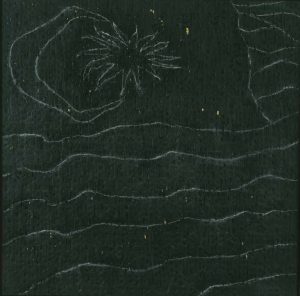
In Disco Lombok Still Life, Noor Mahnun showcases eight drawings of squids on paper. “The squid, against a repetitive pattern rendered in pencil, works on paper. My obsession started when I took part in My Story, My Strength: Doodle for Change, an exhibition in aid of the Women’s Centre for Change in George Town, Penang, in 2015. At first, I wanted to convey the perseverance and patience of women whose lives are affected by abuse,” she explains.

“But in the process of doing the work, the rendering became an obsession, and I got addicted to drawing not only cuttlefish but also the patience-testing, long attention span this series demanded. I have always done patterns but not in minute detail. What was supposed to be an arduous and challenging task became a delightful preoccupation. I could go on rendering for hours. The squid backfired, I suppose. It was chosen because it is languid in the way it moves. It’s smooth, slippery. But it can also swim speedily. Passive. Aggressive. The phallic shape has connotations. Being a printmaker, I have always admired Katsushika Hokusai’s work and one of them featured an octopus and a woman. It is sensual, and I think ‘sensibility’ is the right word to describe it.”

Achievements

After returning to Malaysia at the end of 1997, Noor Mahnun kicked off her career in the arts as a graphic designer. In 1998, she staged her first solo exhibition in Malaysia and participated in group shows. In the following year, she taught in several local institutions and continues to lecture on art theory today.

From 2000 to 2001, Noor Mahnun was an artist-in-residence at Rimbun Dahan in Kuang, Selangor. She concluded the programme with an exhibition of paintings inspired by the location and produced on site. Later, she would return to work as an arts manager from 2006 to 2012.

In 2002 and 2003, she took up a scholarship offered by the Italian Ministry of Foreign Affairs for a printmaking course at Il Bisonte, Florence. Noor Mahnun returned to Kuala Lumpur and ventured into curatorial work at the Valentine Willie Fine Art gallery until 2005. During her stint there, she organised 10 exhibitions by Malaysian and Southeast Asian contemporary artists and wrote the text for the shows.

Noor Mahnun has written over 30 essays and reviews for numerous art shows in Malaysia. She also wrote a paper — Printmaking Archive for Reference, Research, and Regional Link — for a publication by the Nippon Foundation Fellowships for the Asian Public Intellectuals called Encountering Asian New Horizon: Contesting and Negotiating in Fluid Transitions, The Work of 2012-2013.

She is proficient in Bahasa Malaysia, English and German, which allowed her to participate in German-Malay translation workshops organised by Goethe-Institut Malaysia with Holger Warnk and Hedy Holzwarth, lecturers at the Goethe-University Frankfurt am Main Institute for East Asian Philology, Southeast Asia Science.

Noor Mahnun has curated fundraising exhibitions such as Artaid16 ‘Love for Sale’ in 2016 and Artaid17 ‘Bebas’ (Freedom) in 2017 in support of the Malaysian Aids Council.

This month, Noor Mahnun will curate and participate in a group exhibition of 21 artists, Hell Heaven, at Cult Gallery in Kuala Lumpur. This project is in collaboration with Sisters in Islam, an organisation that promotes women’s rights “within the frameworks of Islam and universal human rights”.

Originally published at: http://www.theedgegalerie.com/news/2017/11/embracing-domesticity-through-still-life

Made in Malaysia by Ahmad Shukri Mohamed: Works from 2010 to 2017

Date: September 28 – October 13, 2017
Venue: The Edge Galerie, G5-G6, Mont’ Kiara Meridin, 19 Jalan Duta Kiara, Mont’ Kiara, 50480 Kuala Lumpur (permanently closed)

A diverse and thought-provoking series of works by Malaysian contemporary artist Ahmad Shukri Mohamed.

PREGNANT WITH MALAYSIAN MEANING

The Edge Galerie is showcasing a diverse and thought-provoking series of works by Malaysian contemporary artist Ahmad Shukri Mohamed from Sept 28 to Oct 13.

The 48-year-old artist has been creating art for over 20 years and his eighth solo exhibition will feature 23 new and recent works. Entitled Made in Malaysia: Works by Ahmad Shukri Mohamed from 2010 to 2017, the exhibition will be the first by the artist at our gallery.

The show comprises four series — Postcards from Malaya, Made in Malaysia, Golden Gate and Text. These artworks span seven years and depict Shukri’s efforts to “reformulate” the image of his home country and visually and metaphorically “reread our identity”.

The concept of his art is not merely about highlighting the superficial elements of Malaysian culture or things that are identified as being Malaysian. It is about the economic, social and political developments in Malaysia since independence and how the country has been projected on the global stage.

Shukri’s soul-searching works are imbued with subtle and symbolic elements that trigger a sense of recognition or even chagrin, especially among those who take a keen interest in national affairs.

Formerly a member of the disbanded Matahati group that was established in 1989 and comprised Bayu Utomo Radjikin, Ahmad Fuad Osman, Hamir Soib Mohamed and Masnoor Ramli Mahmud, Shukri has forged ahead with his own identity and a distinct style since the collective’s first group exhibition in 1993.

For instance, his Golden Gate series of meticulous paintings show how the country’s rainforest, teeming with flora and fauna, is constantly at risk of being destroyed. The threat is viewed as a dark force.

The 208.4cm by 289cm Garden of Heaven was completed in 2010. Metaphorically illustrating the Malaysian rainforest, the work signifies the perfection and uniqueness of nature. But how do we utilise, manage and preserve such resources without harming the environment?

In Shukri’s latest works in his Text series, the idyllic landscape is layered with alphabets — a collage of cutouts fixed to the canvas and presented as a blackboard: an allusion to the local education system.

The artist offers his interpretation of the political climate, reduced through a text and colour-only approach. Pregnant with meaning, it is not hard to read between the lines and fathom the thoughts behind each work.

Influenced by his mentor Fauzan Omar, a former art lecturer at Universiti Sains Malaysia and a respected artist, Shukri has incorporated the technique of fabric collage and layering in his work. He was Fauzan’s apprentice for years in the early Nineties.

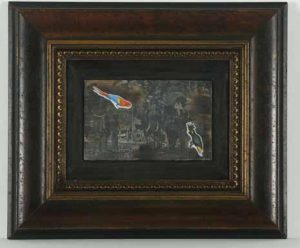
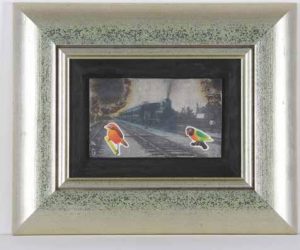
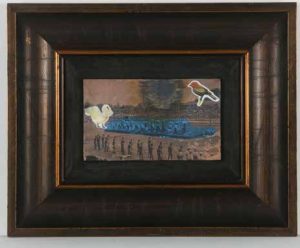
Among the latest works is a series of images of 12 colonial postcards from various states of Malaya. The images have been transferred onto wood and presented in a variety of gilded frames. Offered as a set and entitled I Was Here, the artwork features nostalgic landscapes of the Malayan era, including a kampung house, coconut plantation, colonial buildings by the riverbank, wildlife and a historical scene from Merdeka Day, among others. Shukri has added a quirky touch by incorporating a collage of birds into it.

This series depicts Shukri’s printmaking technique in his mixed media approach to art-making. His creativity extends beyond painting. Also featured as part of his work are specially designed frames for works such as Kami yang Mengikut Perintah — Yes Boss from the Text series, I Was Here from the Postcards from Malaya series and the Made in Malaysia series.

A collection of nine watercolours derived from newspaper clippings of events are illustrated in a liberal manner in the Made in Malaysia series. Symbolic iconography, such as diamond shapes, silhouettes of handbags, luxury cars, armoured tanks, handcuffs, suicide vests and more, comprises some of the top stories published in local newspapers.

Each watercolour is presented in a unique way — every frame is lined with a fabric such as the traditional songket — with a label embroidered with the title of the exhibition, Made in Malaysia.

Shukri’s paintings are also noted for the way they are framed. The framing is done by Jinjit Station by Patisatustudio, located in Puncak Alam, Selangor. Jinjit Station is a social enterprise established by Shukri and his wife, Umibaizurah Mahir @ Ismail, a ceramic artist.

Last year, The Edge Galerie staged a solo exhibition by Umibaizurah entitled Fragile by Umibaizurah: Recent Works 2015-2016.

With the support of Matrix Concepts, The Edge Galerie presents Ahmad Shukri Mohamed’s Made in Malaysia: Works by Ahmad Shukri Mohamed from 2010 to 2017.

ARTWORKS

Link to pdf

Kenny’s Labour of Love

Newly-opened KEN Gallery at Menara KEN TTDI boasts 20,000 sq ft of art space that houses Ken Holdings Bhd chairman’s private art collection and will also feature exhibitions of local and foreign artists.

“I have had the idea to open an art space for more than 10 years,” says KEN Holdings Bhd chairman Datuk Kenny Tan, 60, at a sneak preview of his spanking new KEN Gallery that opened on July 7.  “I have been collecting art for a very long time,” says Tan, as he sat upright at the edge of a plump, leather sofa at his penthouse office.

He recalls that his early artwork acquisitions began in the 1980s. Besides collecting Chinese ink paintings and ceramics, Tan is also an avid supporter of Malaysian contemporary art including the works of Ahmad Zakii Anwar, Ahmad Shukri Mohamed, Chong Siew Ying, Eston Tan and Gan Chin Lee.

“The first time I saw Ahmad Zakii’s painting was at an art dealer’s house in Damansara. And I have never forgotten that painting until today. That was in 1995. It was a painting of two figures in front and back (positions),” says Tan who has modelled for the artist in a painting executed by Zakii two decades ago.

Today, Tan has amassed over 200 artworks by various artists. “It is not about the quantity but the quality of the works, which is why collectors should only buy the best,” points out Tan, who has had a long relationship with international auction house experts dating back to the 1990s.

And he can recall auction room battles for works by Fu Baoshi and other Chinese masters plus a fight or two for prized Chinese porcelain, such as a “Chicken Cup” that got away. But major works by Ding Ying Yong and Bo Yuan, among other ink masters, are now in his collection.

“My aim is to share my personal collection with the public through a rotation of displays at KEN Gallery. It is a small contribution to the community,” adds Tan, who also makes it a point to support and collect local Chinese ink works by Chung Chen San, Cheah Thien Soong , Huang Yao, Datuk Chuk Mor and others.

Housed at Menara KEN TTDI in Taman Tun Dr Ismail in Kuala Lumpur, the gallery space spans about 20,000sq ft in total and is open to the public. Incidentally, the building has a total of 350,000 sq ft of net lettable space. The art space layout comprises a main gallery and three other halls which can be reconfigured with movable wall partitions. It even has a conservation room to restore and repair artworks.

Tan, a prominent property developer and equally passionate art collector, aims to offer his pet project to allow people who own significant artworks but without the space to display them, to hang or install their works at his gallery.

Housed on the mezzanine level of the 13-storey Menara KEN TTDI, the main gallery showcases Tan’s private art collection, which includes modern and contemporary works by distinguished Malaysian artists as well as Chinese calligraphy, paintings and ceramics. Besides Zhongnanhai (Central and Southern Sea) ceramics, there are also Ming and Qing period porcelain exhibited at the Oriental Pavilion, which is laid out as a long corridor of built-in display cabinets that face a panoramic view of the neighbourhood. It even has a private Chinese tea room.

The meticulously-designed gallery space is equipped with sensor lighting and temperature control to keep the artworks in optimum conditions.

For the inaugural exhibitions, Hall 1 features a solo exhibition by Chinese artist Duxi Chen in collaboration with William Fine Art Taipei. Hall 2 showcases acrylic works by Malaysian artist Teh Yew Kiang. Artworks from both solo exhibitions are available for sale.

Kenny Tan Collection

Among the 100-odd artworks selected for display at the main gallery are paintings by Malaysian artists, namely Latiff Mohidin, Datuk Syed Ahmad Jamal, Datuk Ibrahim Hussein, Yong Mun Sen, Patrick Ng Kah Onn, Dzulkifli Buyong, Chia Yu Chian, Khoo Sui Hoe, Yeoh Jin Leng,  Khalil Ibrahim, Datuk Sharifah Fatimah, Juhari Said, and more.

Curated by Syed Nabil Syed Nahar of NN Gallery, the inaugural exhibition of the Kenny Tan Collection promises to “provide an insight of who we are as a society, of the people and places, our customs and traditions, our rituals, way of life as well as our environment as expressed in various medium such as oil, acrylic, watercolour, mixed media, pastels, etching, charcoal, ink paintings and batik”, which aptly aligns with KEN Gallery’s theme: “Space that Tells Stories”.

Art conservation

“Collecting good artworks is not easy, maintaining the artworks is also difficult, which is why there is a dedicated space for art conservation here,” says Tan, who believes in the importance of initiating an art conservation programme through KEN Foundation, which offers scholarship programmes to underprivileged students in selected courses. The foundation was established in 1995 to provide financial assistance to undergraduate students.

“I’m thinking of including art conservation as a course in our scholarship programme for those who really like this direction. Besides becoming an artist, they can further their studies in art conservation — a university will enrol them and a professor will train them. They will then have an opportunity to intern here. That way, there will be more art conservators,” explains Tan, who aims to encourage the development of such professionals in Malaysia.

The KEN Conservation Centre at KEN Gallery is led by Prof Lin Huan Shen from the Department of Cultural Heritage Conservation at the National Yunlin University of Science and Technology, Douliu City, Yunlin County, Taiwan. The centre provides, “consultation and specialises in the conservation of works on paper, paintings, sculptures, decorative objects and artifacts”.

The Kenny Tan Collection at KEN Gallery is ongoing while the Duxi Chen and Teh Yew Kiang solo shows will end on July 30.

Originally published at: http://www.theedgegalerie.com/news/2017/07/kenny%E2%80%99s-labour-love

Blooms by Tang Juey Lee

Date: April 20 – May 5, 2017
Venue: The Edge Galerie, G5-G6, Mont’ Kiara Meridin, 19 Jalan Duta Kiara, Mont’ Kiara, 50480 Kuala Lumpur (permanently closed)

Malaysian artist Tang Juey Lee has been painting orchids for the past 40 years and is better known on the Singapore art scene where the press has dubbed him “Singapore’s Orchid Artist”. This show also marks the 30th year since Tang’s first exhibition in Kuala Lumpur in 1986. At the time, the artist painted mainly with watercolour on rice paper. He has since progressed to acrylic paint as his preferred medium on Chinese rice paper with gold flecks.

A PASSION FOR ORCHIDS

Dubbed “Singapore’s Orchid Artist”, 63-year-old Malaysian artist Tang Juey Lee is better known in the city state as he graduated from its Nanyang Academy of Fine Arts in the 1970s.

Tang held most of his exhibitions in Singapore, where his meticulous style of painting orchids earned him many accolades. Moreover, the orchid is Singapore’s national flower. But the artist took a 23-year hiatus in the 1990s to establish his own art school and only resumed exhibiting in 2014. Collectors welcomed him with open arms, buying up all his work.

His exquisite paintings of orchid blooms, typically matched with parrots, geese, roosters and ducks, can be said to belong to the flower-and-bird genre of Chinese paintings but combined with Western Realism. Such works have a following among collectors who particularly favour the gongbi style of Chinese art, which focuses on Realist techniques.

Tang initially painted with watercolour on rice paper but progressed to acrylic paint diluted with water to achieve more vibrant and colourful compositions. In his only second one-man show in Kuala Lumpur since 1986, Tang will showcase 20 paintings at The Edge Galerie. Their prices range from RM5,000 to RM21,000 each.

“I paint what I see,” says the veteran artist, adding that he prefers to observe flowers in full bloom, particularly in the Singapore Botanic Gardens, where he practises life sketching to hone his skills in rendering lifelike compositions.

Tang’s body of work comprises a variety of orchids — Dendrobium; Cymbidium or boat orchid; Oncidium, commonly known as the Golden Shower or Dancing Lady; Renantanda; Phalaenopsis Blume or moth orchid; and more.

“I have painted over 300 different orchid species in the past 40 years,” remarks Tang.

In addition to these blossoms, the artist incorporates koi, squirrels, kittens and chicks, among other things, as well as insects such as bees and butterflies into his work.

“I recently included animals in my paintings to complement the orchids,” explains Tang, who began pairing his works of flora with fauna in 2013 and using acrylic in 2015.

TECHNIQUES

Tang embraced the traditional bird-and-flower theme and enhanced his subject matter by using acrylic paint on rice paper instead of the conventional ink or watercolour.

“The materials I use are high-quality acrylic paints by Daler-Rowney and rice paper dusted with gold flecks imported from China,” he explains.

“I chose acrylic over watercolour because of its lasting quality. Its fast-drying effect, which is similar to that of watercolour, allows me to work on several paintings at one time. The vibrancy of acrylic paint works best for my subject matter.”

Viewers of Tang’s expressive paintings will feel a great sense of joy. He creates pleasant compositions by carefully placing his choice of flowers with selected animals.

In Lazy Afternoon, created specifically for the show and measuring 86cm by 96cm, Tang illustrates the red Renantanda orchid dispersed across the picture plane in harmony with kittens playing with chicks in the foreground. One of the kittens near a strawberry plant is depicted trying to catch a fish in a net. A snail is seen slithering on the ground.

Such details distinguish Tang as an imaginative and meticulous painter who not only focuses on portraying orchids in their truest form but also adds simple touches to evoke happiness and positive vibes.

The yellow-green leaves that frame the deep red blooms, which dominate the painting, offer a balanced configuration.

“One of the important elements of my work, besides colour, is composition. My aim is to create harmonious paintings that make people happy,” says the artist.

Prosperity Koi illustrates a school of nine of the fish, which have symbolic significance in Chinese culture. The offering of nine koi to new parents is considered the most meaningful gift of all because it will bless the child with two secrets of success — determination and flexibility — which are traits believed to be found in koi.

But the importance of nine koi extends beyond the story of success and harmony to include luck, wealth and protection. The number nine represents completeness and eternity in Chinese culture.

Fluttering Grace depicts an intriguing combination of the Vanda “Miss Joaquim” orchid, banana trees and a company of macaw parrots perched on tree branches. Measuring 68cm by 106cm, the artwork illustrates the landscape of Southeast Asia.

Also apparent in Tang’s body of work are visually stimulating lines and shapes. Illustrated in the 90cm by 68cm Joyful Bliss is the alluring Phalaenopsis Blume orchid with a company of budgerigar parrots either fluttering in the air or perched on a tree branch. The common pet parakeets are illustrated in pastel blue and green.

Traditionally, owning or gifting such a painting reflects a cultured mind or a person schooled in Chinese aesthetic and customs. It goes beyond displaying something that is symbolic of prosperity or merely wishing good luck.

EDUCATION

Born in Johor Baru, Tang studied at Singapore’s Nanyang Academy of Fine Arts from 1974 to 1976 and graduated with a diploma in Western art.

Under the tutelage of renowned Singaporean pioneer artist, Georgette Chen (1906-1993), Tang learnt to incorporate into his paintings Eastern sentiments with Western techniques.

Paris-trained Chen, who painted in the post-Impressionism style, taught Tang the fundamentals of Western compositions, such as perspective.

Tang himself taught at a college that he founded — Raphael Academy of Art — in Johor Baru between 1991 and 1998.

“I was the principal of the now defunct college and taught watercolour to diploma students for seven years. At the same time, I was creating artworks to sell to collectors in Singapore and Australia,” he says.

Although his passion for producing orchid paintings is immeasurable, Tang claims to not have any emotional attachment to his work.

“All of my paintings are sold upon completion. I do not keep any of my old work,” he says when asked if he has an inventory of artworks created over the years.

His tutor Chen had kept most of her paintings until her death in 1993, when the Lee Foundation took custody of her collection. Most of her paintings were then donated to the Singapore Art Museum in 1994.

GLOBAL PRESENCE

According to Tang, who has held international exhibitions since 1977, his artworks are well received in Singapore, Australia and Taiwan.

“My first and only exhibition in Kuala Lumpur was in 1986. Now, 30 years later, I have returned to show my new work,” he says.

Held at Shangri-La Hotel, Kuala Lumpur, the 1986 exhibition was said by the artist to have been supported by Joyce Kuok, then wife of business tycoon Robert Kuok.

Entitled The Dream Landscape Series, the show comprised around 30 watercolour orchid paintings and was officiated at by the then Urban Development Authority chairman Tan Sri Murad Mohd Noor.

Tang was also commissioned by hotels and restaurants in Singapore, Hong Kong and Malaysia to paint for them.

His artworks are in various private collections abroad as well as in the hands of public institutions and corporations, including the Singapore Art Museum, Singapore Changi Airport, Citibank, Gulf International Bank, Shangri-La Group and Royal Holiday Inn in Singapore.

ARTWORKS

Link to pdf

Eternally Beautiful Blooms

Nanyang Academy of Fine Arts alumnus Tang Juey Lee can claim the rare honour of being taught by distinguished Singapore artist Georgette Chen,but his painting style is quite distinct from his late teacher’s.After 40 years of painting, Tang’s rare solo show in Kuala Lumpur encapsulates all that he has learnt and more.

Called “Singapore’s Orchid Artist”, 63-year- old Malaysian painter Tang Juey Lee is better known in the city state — where

he graduated from the Nanyang Academy of Fine Arts in the 1970s — than he is at home. Since the 1970s, Tang has been more active exhibiting in Singapore,where his meticulous style of painting has earned him many acco- lades. He took a 23-year hiatus in the 1990s to establish his own art school and only resumed exhibiting in 2014. Collectors welcomed him back by buying up all of his works.

His exquisite paintings of orchid blooms — typically matched with parrots, geese, roosters and ducks — can be categorised under the flower-and-bird genre of Chinese paintings combined with a Western sense of realism.These works have a following among collectors who, in particular, favour the gongbi style of Chinese art that focuses on a realist technique.

Initially working with watercolours on rice paper, Tang has progressed to using acrylic paint diluted with water to achieve a more vibrant and colourful composition. In only his second one-man show in Kuala Lumpur since 1986,Tang will showcase about a dozen paintings at The Edge Galerie. Prices range from RM5,000 to RM21,000 for each painting.

“I paint what I see,” says Tang in an interview with The Edge at the gallery in Kuala Lumpur, dismissing the notion of downloading images from the internet, a common practice among today’s artists.

Breaking Dawn, 2017, 68cm by 90cm, acrylic on rice paper
Fluttering Grace, 2017, 68cm by 106cm, acrylic on rice paper

The veteran artist says he prefers to observe flowers in full bloom, particularly at the Singapore Botanic Gardens, where he practises life sketching to hone his skills in creating liveliness in his compositions.

Tang’s body of work comprises a variety of orchids, such as Dendrobium, Cymbidium or boat orchid, Oncidium (commonly known as golden shower orchid or dancing-lady orchid) Renantanda, Phalaenopsis Blume or moth orchid and more.

“I have painted over 300 different orchid species in the past 40 years,” says Tang.

In addition to the blossoms, he incorporates creatures like carp, squirrels, kittens, chicks as well as insects, including bees and butterflies, in his artworks. “I recently included animals in my paintings to complement the orchids,”says Tang, who began pairing his works of flora with fauna in his in 2013 and using acrylic in 2015.

In Blooms by Tang Juey Lee, the artist is show- casing 20 paintings on rice paper, created in 2016 and 2017.

Technique

Employing the traditional bird-and-flower theme, Tang enhances his approach to his subject matter by using acrylic paint on rice paper instead of the conventional ink or watercolours. “I use high quality acrylic paints by Daler-Rowney and imported rice paper dusted with gold flecks from China,” says Tang.

“I choose acrylic over watercolour because of its lasting quality.Its fast-drying effect,which is similar to watercolours, allows me to work on several paintings at a time. The vibrancy of acrylic paint works best for my subject matter.”

Tang’s expressions convey a sense of enjoyment to his viewers.He creates pleasant compositions by carefully placing his choice of flowers with the selected animals.

In Lazy Afternoon (86cm by 96cm), created this year for this show, the red Renantanda orchid is dispersed across the picture plane in harmony with kittens playing with chicks in the foreground. One of the kittens, near a strawberry plant, is depicted in the act of catching a fish in a net.A snail is seen slithering on the ground.

Joyful Bliss, 2017, 90cm by 68cm, acrylic on rice paper
Prosperity Koi, 2017, 90cm by 68cm, acrylic on rice paper

These unique details distinguish Tang as an imaginative and meticulous painter, who does not just focus on portraying orchids in their truest form but adds simple touches to exude happiness and positive vibes. The yellow-green leaves that frame the deep red blooms, which dominate the picture, offer a balanced configuration.

“One of the important elements in my work — besides colour — is composition.My aim is to create harmonious paintings that make people happy,” says Tang.

Prosperity Koi illustrates a school of nine carp, which in Chinese culture is of symbolic significance. The offering of nine koi to new parents is considered one of the best wishes and most meaningful gifts one can give. It signifies success for your children because they possess the two secrets of achievement — determination and flexibility — which are traits believed to be found in koi. The meaning of nine koi extends beyond the story of success and harmony to include luck,wealth and protection.The number nine represents completeness and eternity in Chinese culture.

Fluttering Grace depicts an intriguing combination of the Vanda “Miss Joaquim” orchid with banana trees and a flock of macaws perched on tree branches. Measuring 68cm by 106cm, the artwork, which features Singapore’s national flower, illustrates the landscape of Southeast Asia.

Apparent in Tang’s body of work are visually stimulating lines and shapes. Illustrated in Joyful Bliss is the alluring Phalaenopsis Blume orchid with a company of budgerigars either fluttering in the air or perched on a tree branch. In the 90cm by 68cm work, the common pet parakeets are illustrated in pastel blue and green.

Traditionally,owning or giving such paintings reflects a cultured mind or a person schooled in Chinese aesthetics and customs. It goes beyond displaying something that is symbolic of prosperity or merely wishing good luck.

Education

Born in Johor Baru,Tang was enrolled in the Nanyang Academy of Fine Arts, Singapore, from 1974 to 1976 and graduated with a diploma in Western Art. Under the tutelage of renowned pioneer Singapore artist, Georgette Chen (1906-1993), Tang learnt to incorporate Eastern sentiments with Western techniques in his paintings.

Paris-trained Chen, a post-Impressionist painter, taught Tang the fundamentals of Western composition. A former educator himself, Tang taught at the college he founded, Raphael Academy of Art, in Johor Baru from 1991 to 1998.

“I was the principal of the now-defunct college and taught watercolours to diploma students for seven years. At the same time, I was creating artworks to sell to collectors in Singapore and Australia,” says Tang. Although his passion for producing orchid paintings is immeasurable, he says he does not have any emotional attachment to his artworks.

“All of my paintings are sold upon completion. I do not keep any of my old works,” he says,when asked if he has an inventory of artworks created over the years.

This is in contrast with Chen, who kept most of her paintings until her death in 1993. Her collection was under the custodianship of the Lee Foundation after her death. Most of her paintings were donated to the Singapore Art Museum in 1994.

Global presence

According to Tang, his artworks are well received in Singapore,Australia and Taiwan and he has exhibited internationally since 1977.

“My first and only exhibition in Kuala Lumpur was in 1986. Now, 30 years later, I have returned to show my new works,” says Tang. Held at Shangri-La hotel, the artist says the 1986 exhibition was supported by Joyce Kuok, the then wife of business tycoon Robert Kuok. Titled The Dream Landscape Series, Tang’s first one-man show in Kuala Lumpur, which showcased over 30 watercolour orchid paintings,was opened by the then Urban Development Authority chairman Tan Sri Murad Mohd Noor.

Tang has produced commissioned works for hotels and restaurants in Singapore, Hong Kong and Malaysia. His artworks are in the collections of public institutions and corporations, including the Singapore Art Museum, Singapore Changi Airport, Citibank, Gulf International Bank, the Shangri-La Group and Royal Holiday Inn in Singapore as well as various private collections abroad.

Link to pdf

Remembering Michael Sullivan

Distinguished Southeast Asian art historian T K Sabapathy remembers his late lecturer, Michael Sullivan, a pioneer in the field of art history in the region.

“No other teacher in my undergraduate years employed language as Sullivan did,” said T K Sabapathy, 78, at a public lecture, “Studying and Writing Histories of Art: A Beginning”, on March 18. Held at Ilham Gallery, Kuala Lumpur, in collaboration with University of Malaya, the two hour event, complete with slide presentation, attracted about 100 artists,curators,gallery owners, students and lecturers.

Sabapathy described Michael Sullivan’s impact as an educator, art historian, curator and writer.From 1954 to 1960, Sullivan taught history of art at the then University of Malaya in Singapore. He died in September 2013.

Sullivan’s research and writing on art in Southeast Asia, and how he inaugurated the academic study of art and its history in Malaya and Singapore, was recounted by Sabapathy, an adjunct associate professor with the Department of Architecture of the School of Design and Environment at the National University of Singapore.

The art history teacher examined Sullivan’s role as a curator of archaeological artefacts and art at the University of Malaya Art Museum when it was established in 1955.

“I remember seeing pictures painted in oil and ink by artists from Malaya and Singapore, hung adjacent to ceramic vessels and partial images of Buddha cast in bronze. It was exhilarating. There was nothing like it anywhere else in Singapore, or in Malaya, as far as I can recall. It was part of our daily student life. I felt Sullivan intended to convey relationships between these distant objects forcefully. He may well have intended to provide an environment that was visually stimulating and provoked curiosity,” said Sabapathy.

Life and times

Born in Toronto, Canada, and raised in London, Sullivan studied architecture at Oxford University. Upon graduating, he worked as a volunteer in China during World War Two, delivering medical supplies for the International and Chinese Red Cross organisations.

In 1943, he married Wu Baohuan, a biologist who gave up her career to help him with his scholastic and collecting pursuits. Wu, fondly known as Khoan, died in 2003. “She was his partner professionally. Virtually all of his publications were dedicated to Khoan,” said Sabapathy.

He also offered a glimpse of Sullivan’s personal life. “Khoan and Michael were inseparable. He repeatedly acknowledged how important she had been in his professional life.She made connections,she built bridges, she persuaded patrons to donate artworks to consolidate collections while he was the curator of the art museum in the then University of Malaya in Singapore.

“She was his assistant, dabbling as his secretary, protecting him. She sat at a table in a connecting space between the study and his office. As students, if anyone wished to meet with Sullivan,we had to furnish Khoan with a reason.And convince her of our need to see him. She never denied entry, or access to him.”

Sabapathy quoted Jerome Silbergeld, currently professor of Chinese Art History at Princeton University,as saying,“He (Sullivan) has a wonderfully relaxed disposition, he’s perhaps even a touch shy,very much a gentleman,and always gracious.” Silbergeld was a student of Sullivan’s during his stint as a lecturer and Professor of Oriental Art at Stanford University from 1966 to 1985.

Malayan art

Well-known Singaporean artist Cheong Soo Pieng (1917-1983) famously painted Khoan in a work called Portrait of Khoan Sullivan, 1959.

“Sullivan installed Cheong Soo Pieng on a register apart from other artists,bragging about him more frequently than any other artist, regarding him as the most innovative,imaginative …and as having immense effect. He said: ‘Soo Pieng’s influence on the younger painters of Singapore and Malaya has been powerful and direct. Perhaps too direct.His angular figures,formalised portraits and his expressionistic colours are the mark of a highly sophisticated painter, whose consistent style has given rise to a school of young painters who copy his forms and colours’. And wait for this: ‘Just as the painters of Paris have copied (Pablo) Picasso and (Georges) Braque’.”

Sabapathy added: “I have not come across a published opinion on Soo Pieng [given] in the 1950s that is comparable to Sullivan’s …in such sharpness and in such an exalted tone.”

He highlighted the fact that Sullivan never made any reference to “Nanyang” art. “When he names artists from Singapore, he envisions and represents their creative work not as Singapore art but as Malayan art. Not as Nanyang but as Malayan. I have, by the way, not encountered the term ‘Nanyang’ in any of Sullivan’s writings. That is a matter that could be treated separately.”

Sabapathy: I bid Michael Sullivan adieu. I also salute a wonderful guru who introduced me to the world of art

The Khoan and Michael Sullivan collection

Sabapathy said Sullivan spoke highly of contemporary Malayan art, by referring to it as “the state of our cultures”. “His view was that the students should not only know what was before but be aware of what is culturally and historically (significant).”

He also said that Sullivan was “actively involved with artists and art in Singapore,with organising exhibitions of their works”, just as he did when he was residing in Chengdu, China, in the 1940s. “Hence,works by artists such as Soo Pieng, Chuah Thean Teng and Suri Mohyani were acquired via donation and purchase.”

More than 400 works from the collection of Khoan and Sullivan,acquired over seven decades, have been donated to the Ashmolean Museum in Oxford, England. The collection includes books, photographs as well as artworks by Chinese painters Qi Baishi (1864–1957), Zhang Daqian (1899-1983), Pang Xunqin (1906–1985), Ding Cong (1916-2009) and so on.

Among Sullivan’s significant publications produced during his long and illustrious career as a historian of Chinese art are The Birth of Landscape Painting in China (1962), Symbols of Eternity (1979), The Birth of Landscape Painting in China: The Sui and Tang Dynasties (1980), The Meeting of Eastern and Western Art (1989), Art and Artists of Twentieth Century China (1996), The Arts of China (1973, 1984), Modern Chinese Art: The Khoan and Michael Sullivan Collection (2001).

“I bid Michael Sullivan adieu. I also salute a wonderful guru who introduced me to the world of art and, in incalculable ways, sustained me all my life. I thank you,” said Sabapathy, concluding his lecture.

Link to pdf

The Edge Auction 2017

Date: March 5, 2017
Exhibition preview: February 23 – March 3, 2017
Venue: The Edge Galerie, G5-G6, Mont’ Kiara Meridin, 19 Jalan Duta Kiara, Mont’ Kiara, 50480 Kuala Lumpur (permanently closed)

The fifth edition of The Edge Auction highlights invigorating works by all the top names in Malaysian art in the 118 lots going under the hammer. Among the modernist works of our revered artists are significant paintings by Latiff Mohidin, Datuk Ibrahim Hussein, Datuk Syed Ahmad Jamal, Yusof Ghani, Jolly Koh, Awang Damit, Datuk Sharifah Fatimah Zubir and Khoo Sui Hoe.

Listen to BFM 89.9 podcast “Auction on Southeast Asian Art” by Sarah Abu Bakar, produced by Lim Soon Heng here: http://www.bfm.my/sarah-abu-bakar-auction-southeast-asian-art.html

Written article posted at: https://www.theedgegalerie.com/auction/edge-auction-2017